(MEXICO CITY) – Breaking away from the traditional image of an old Yucatecan hacienda —with its rattan furniture and an average stay of three nights— to create a concept that both preserves and innovates, ensuring comfort and luxury, earned Chablé Resort & Spa the Interior Design Project of the Year Award.
In what some might consider a bold move, Paulina Morán and Jorge Borja, the creative minds behind this design, conceived a space that creates a striking dialogue between the past and a refined, contemporary present.
“It was a risk we took —we wanted to do something different,” says Borja. “We knew from the beginning we couldn’t repeat the same kind of hacienda restoration that Roberto Hernández did, even though his work is impeccable.”
PROJECT. A former Yucatecan hacienda transformed by two Mexican architects into a luxurious retreat rooted in Mayan heritage.
Comfort was key to the project’s success, but so was the careful integration of historical recovery. The design preserved the shell of the original structures, yet, since some were already being demolished, the architects opted to create a new concept rather than restore what was lost.
The main house of the hacienda was reimagined to offer a traditional experience. “It was an abandoned warehouse,” recalls Morán, who led the interior design. “We tried to preserve all the important walls —we had to know exactly where to open them so nothing would collapse.”
That area, now housing the reception, invites guests to read, check emails, or simply relax —but not sleep. It’s a space that transports visitors to the past, evoking the Yucatecan way of life of another era.
The original floors were preserved and repainted in new colors. “Local architects initially questioned our decision,” Morán recalls with a laugh. “They couldn’t believe we wanted to use the same kind of tile their grandmothers had.”
Every cushion and decorative element in the space was handcrafted by local artisans. “We provided the linen and silk, and they produced the textiles through a foundation called Hilando México,” explains Morán.
Glass Boxes in the Jungle
Inside, 40 luxury villas are divided by original, unrestored stone walls —each creating the feeling of a time machine bringing guests into the present. “We wanted guests to feel as if they were inside a glass box —to wake up, open the curtains, and see the jungle,” says Borja.
The rooms, all elevated about 90 centimeters above ground, give the sensation of floating over the forest floor. Despite the modern accent, natural materials like wood bring a tactile connection to the surroundings.
“We wanted every touch to awaken the senses —to feel the cool regional stone under your feet, the texture of the wood, the temperature of the air,” notes Morán.
Even the bathrooms are designed to engage the senses. Stone monoliths serve as sinks, topped with solid wood slabs; custom-made ceramic basins are colored like cenotes inside and earth-toned outside. The shower is enclosed within a wooden cube —a recurring motif throughout the resort, becoming a visual signature.
A Luxury Cenote
The 300-hectare property includes a natural cenote transformed into a spa. Suspended above it, cube-shaped treatment cabins echo the form of the room showers.
The wellness services use biodegradable products and ingredients grown in the hotel’s ka’anchés (traditional Mayan gardens), also featured in the restaurant’s cuisine.
The color of the cenote mirrors the private plunge pools of the villas and the main pool area.
“For both interiors and exteriors, we used regional materials like galarza stone and white cement mixed with crushed marble,” Morán explains.
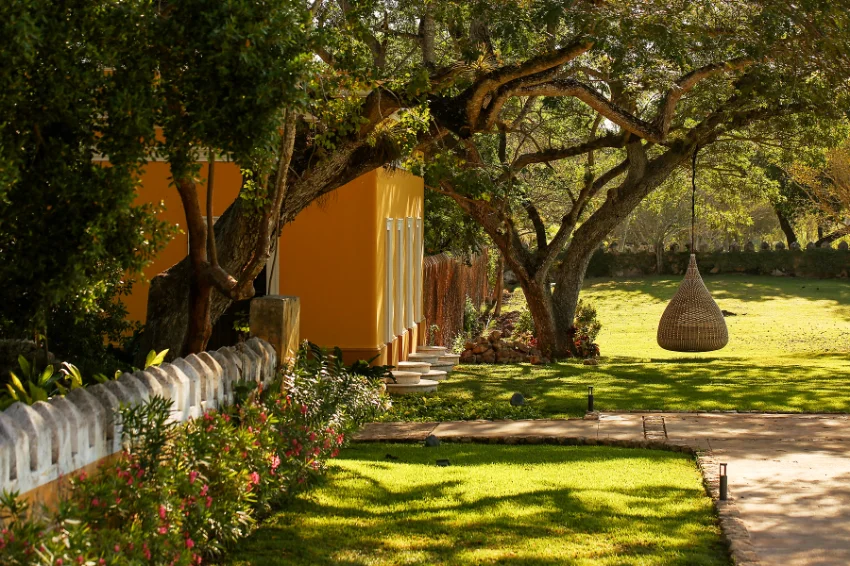
All existing trees were preserved, and the project was designed around them. Fallen trees struck by lightning —a common occurrence in the area— were turned into furniture.
To stay within budget, the architects prioritized local materials and artisans. While there are a few signature pieces (like lighting by British designer Tom Dixon), most of the furnishings were crafted in Mexico.
Each detail was supervised closely —even down to the waxing of the parota wood tabletops.
“We had to fight through challenges —we were literally in the middle of nowhere,” recalls Morán. “But local suppliers helped us overcome every obstacle.”
The lighting fixtures, for instance, were also locally made —one features guaje gourds painted black and lined with gold leaf.
A Timeless Mexican Luxury
Since opening in February, the hotel’s rates start at $1,100 USD per night. Around 70% of guests are international visitors between 35 and 60 years old, drawn to this refined expression of Mexican luxury.
Despite being deep in the jungle, the entire hacienda is fully accessible, with pathways designed for wheelchair access.
“We wanted guests from New York or Russia to experience this Maya-chic dimension —a culture often forgotten or misrepresented,” says Morán.
The recognition from Obras Magazine adds to an earlier global distinction: the Prix Versailles 2017, awarded by UNESCO and the International Union of Architects.
Announced on May 12, 2017, the award celebrated the seamless integration between exterior and interior at Chablé Resort & Spa, placing it above world-renowned firms such as Rockwell Group and Philippe Starck.
The accolade honored the disruptive nature of the project —a contemporary luxury hotel housed within a 19th-century hacienda.
Among the Prix Versailles jury were Pritzker Prize laureates Toyo Ito and Wang Shu, as well as essayist Gilles Lipovetsky. Conceptualized in 2010 but delayed for years due to funding, the project eventually went viral, promoted as “the best hotel in the world.”
Today, nestled in the quiet town of Chocholá, just 25 minutes from Mérida, Chablé Resort & Spa stands as a global reference —celebrated across social media and featured in the world’s most exclusive travel publications.